The agent raises disk_high
D: on srv-books crosses 90%. The agent sends one event with the volume and the number. It has been sending a heartbeat every five minutes for months, so the hub already has the trend.
07:12The hub opens an alert and starts BE AI
Alert "srv-books · disk D: 96%" opens as a warning. The disk_high recipe starts: history first, then the machine.
07:12BE AI reads, then asks
get_samples over 7 days shows +0.9% a day. get_diagnostics, list_processes, the event log and a bounded directory listing, eight read-only calls in all, show D:\Backups at 231 GB of a 500 GB volume. Every call is on the record.
07:12It concludes and proposes nothing yet
"Degraded, high confidence. Backups are the cause; nothing else unusual. Review files older than 30 days before deleting." The alert notification goes out a minute later with this attached.
07:14Sam opens the console on the phone and replies in the thread
"List what's older than 30 days first, then clean it up." BE AI files a read-only listing as a proposal. Sam approves it; it runs; 38 files, 212 GB.
07:19The delete is proposed, then approved
One proposal, the exact command, the reason "same 38 files you reviewed, your notes say keep 30 days". Sam approves. It runs in 2 seconds. Result: completed without errors.
07:21Verified and closed
"Verify the effect": BE AI reads the disk again: 54% used on a 500 GB volume. The next heartbeat resolves the alert on its own. The thread, both approvals and the output sit in the audit trail under Sam's name.
auditsrv-books07:12 → 07:2507:12:03event disk_highD: 96.1% · agent07:12:04alert openedwarn · disk:D07:12:05run startedrecipe disk_high · hub:event07:12:06call get_sampleshours 168 · auto07:12:08call get_diagnosticsauto07:12:11call list_processestop 10 · auto07:12:31run donedegraded · high · 8 tool calls07:13:05notifiedsms → on-call · email → ops@07:14:40run startedchat · sam07:15:02proposal approvedrun_shell (listing) · sam07:15:05resultok · 2.4 s07:19:10proposal approvedrun_shell (delete) · sam07:19:12resultok · 1.8 s07:21:30run donehealthy · verify the effect07:25:10alert resolvedD: 54% · heartbeat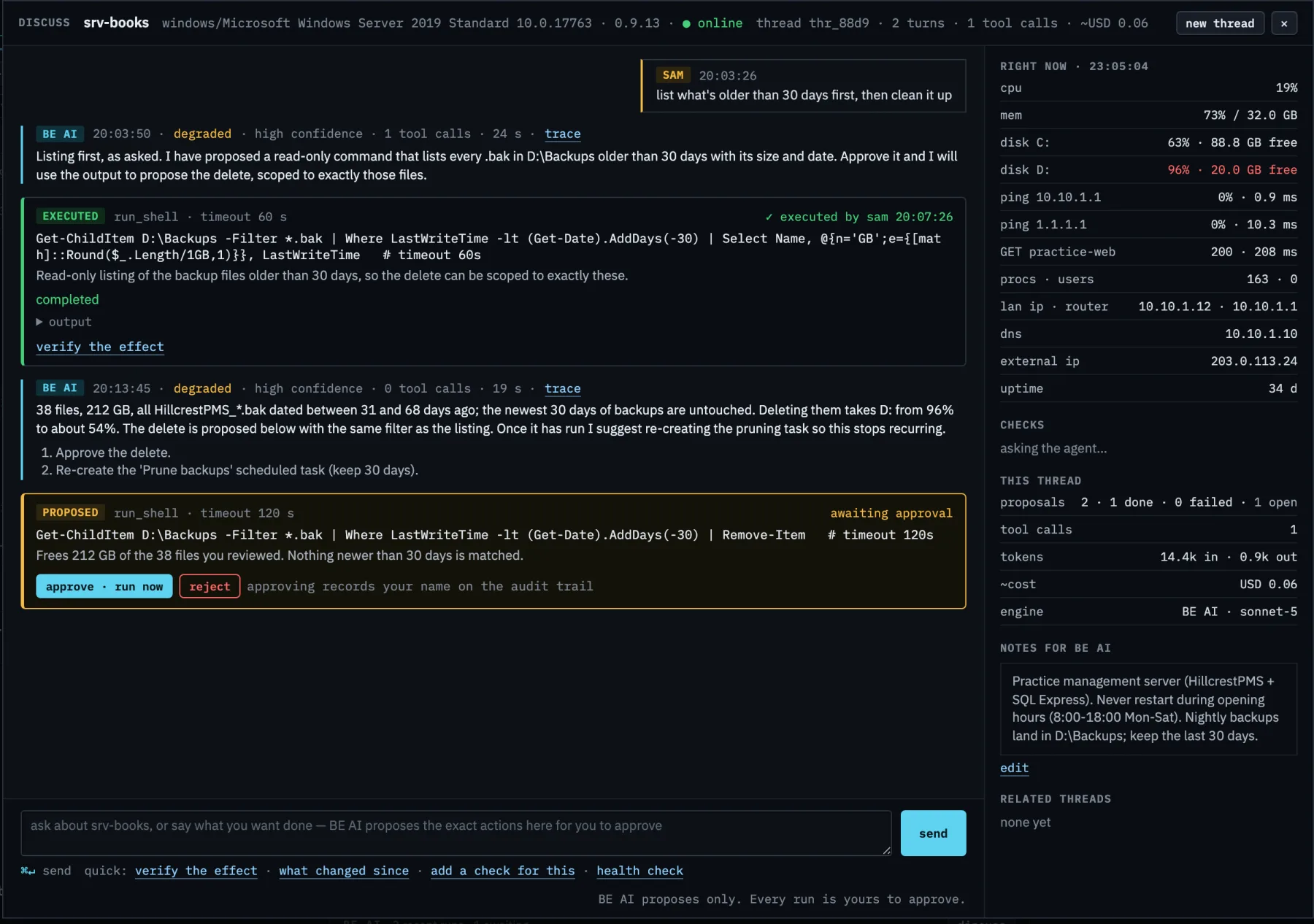
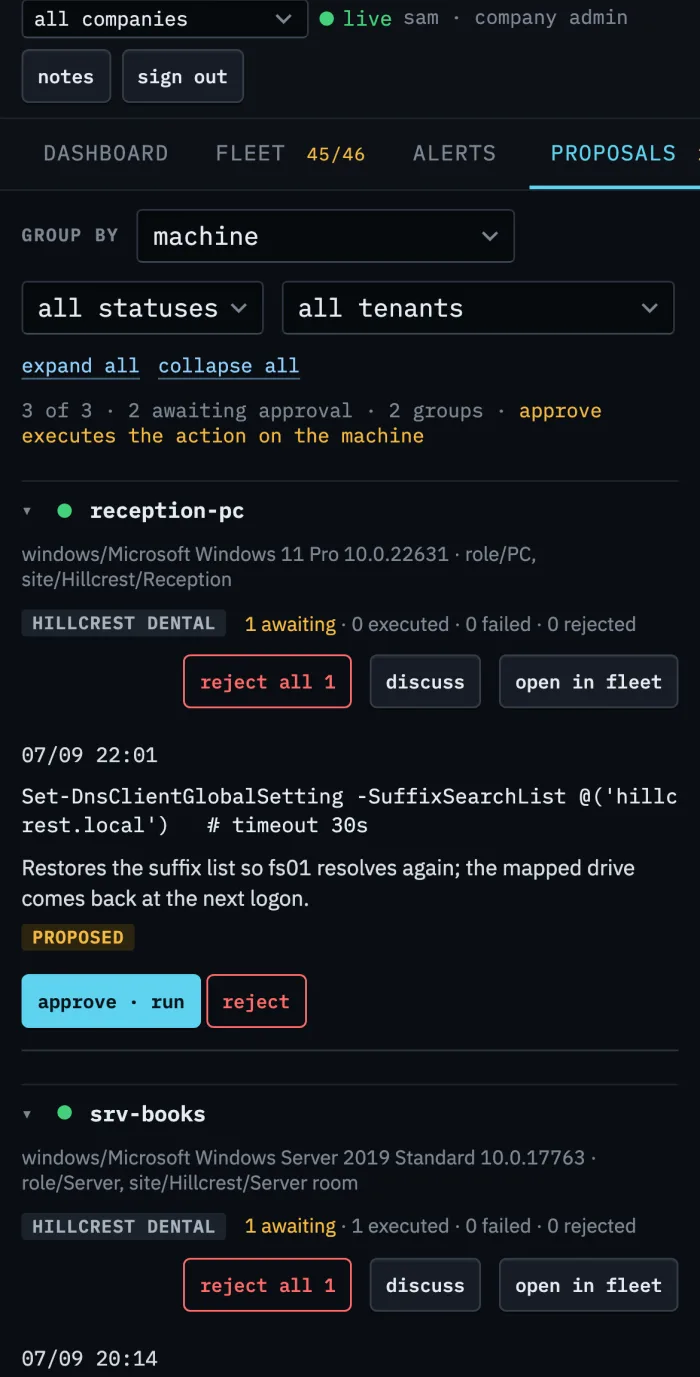
The queue on a phone browser. Approve from wherever you are.
the rules the loop obeysWhat BE AI can and cannot do, in code, not in a policy document.
A fixed set of tools
Diagnostics, metrics, processes, services, logs, checks, network facts, and the hub's own history. Nothing else exists for it to call.
Budgets
At most 15 tool calls and 12 turns per run, three minutes, a cap on runs per company per day. It has to conclude.
Untrusted input
Log lines, process names and file paths are data. A hostile string in a log cannot make the model do anything the tools do not allow.
Proposals need a person
Every mutating tool is behind an approval on the hub. The model cannot approve its own proposal, and neither can a scheduled job.
Shell is local policy
Whether a machine allows shell commands at all is decided in its own config file. The hub cannot switch it on.
Everything is recorded
Runs keep their transcript. Proposals keep their output. Approvals keep the name. Sign-ins and failures too.
More on BE Hub BE Hub overview Plans & pricing Service desk & tickets 38-tool MCP server Disk-full forecast guide The same alert, with and without BE AI. Autonomy AI RMM Classic RMM Multi-site Windows estates that need a named person on every change. When your customers will not put the estate in a tool you cannot place. A global product. Put the hub where your policy says. Most outages announce themselves weeks ahead. The primary RMM. One rule: AI cannot write. Run BE Hub beside the incumbent. Keep one. Cut the other. The AI can read. Only a person can write. Internal IT that has to control the change, not just see the estate. Security checks Reports, digest and knowledge base Integrations Atera alternative RMM pricing in AUD Essential Eight & M365 posture NinjaOne alternative (AU) Datto & ConnectWise alternative CVE patching with 1-click rollback VMware ESXi & Proxmox ZFS monitoring Teltonika & OPNsense monitoring